Surya Garigipati Photography & Films is a Muslim wedding photographer in New Jersey covering the mehndi or dholki, the nikah at a mosque, at home or at the hall, the baraat and rukhsati, and the walima, for Pakistani, Indian Muslim and Bangladeshi families. A female photographer covers ladies-only halls, galleries stay private, and the studio is rated 4.9 on Google.
At a glance
| Weddings | Pakistani, Indian Muslim and Bangladeshi weddings, and mixed weekends where a nikah sits beside a Hindu or Christian ceremony |
| Events | Dholki and mehndi, nikah, baraat and rukhsati, walima |
| Etiquette | A female photographer for the ladies’ side when wanted; who may be photographed and where agreed in advance; galleries private and password-protected |
| Studio | Surya Garigipati Photography & Films LLC, Flemington, New Jersey |
| Where | Edison, Jersey City, Paterson and across New Jersey; Queens and the Bronx |
| Travel | New Jersey, New York City and Philadelphia included in every collection |
| Experience | Weddings since 2013; more than 400 South Asian celebrations |
| Reviews | 4.9 on Google from 38 public reviews: read them |
What a Muslim wedding photographer needs to know first
- Modesty and separation. Some families hold the mehndi, the nikah or the whole reception with men and women in separate halls, or with a partition. We bring a female photographer for the ladies’ side when that is wanted, and we agree in advance who may be photographed and where.
- The nikah may not be at the venue. It is often at a mosque, at home or in a small room at the hall, on a different day from the big reception, and sometimes the bride and groom sign in different rooms with the witnesses moving between them.
- Privacy. Many of our Muslim couples ask that their photographs never appear online. The gallery is private and password-protected, and nothing is shared on our own pages without permission; everything on this site is here with the couple’s blessing.
- The timing is late. A Pakistani baraat is often an evening event, with dinner at ten and the rukhsati after midnight, so the whole evening is photographed under our light rather than daylight.
The dholki and the mehndi
The dholki evenings of singing and drumming at home in the weeks before, and the mehndi proper, with the bride under a yellow or green dupatta and the families dancing in choreographed sets, are the warmest events of the week. A Pakistani mehndi is often a full production with a stage, a decorated swing and a dance-off between the two families; we light the stage from the front for the performances and keep the rest of the room as it is, so the marigolds and the candles read true. Our mehndi and haldi guide covers the lighting.
The nikah
The nikah is a contract and a prayer, and it is short: the imam’s khutbah, the ijab and qubool asked three times, the signing, the dua and the families’ embrace, twenty to forty minutes in all. It is the quietest moment of the week, photographed without flash and from the side, with one photographer with the bride and one with the groom if they are in separate rooms. The frames that matter are the signing, the bride’s face when she says qubool, the fathers, and the moment the two families meet afterwards. If the nikah is in a mosque, we confirm with the imam beforehand where we may stand and whether photography is permitted in the prayer hall; usually it is, from the back and the sides.
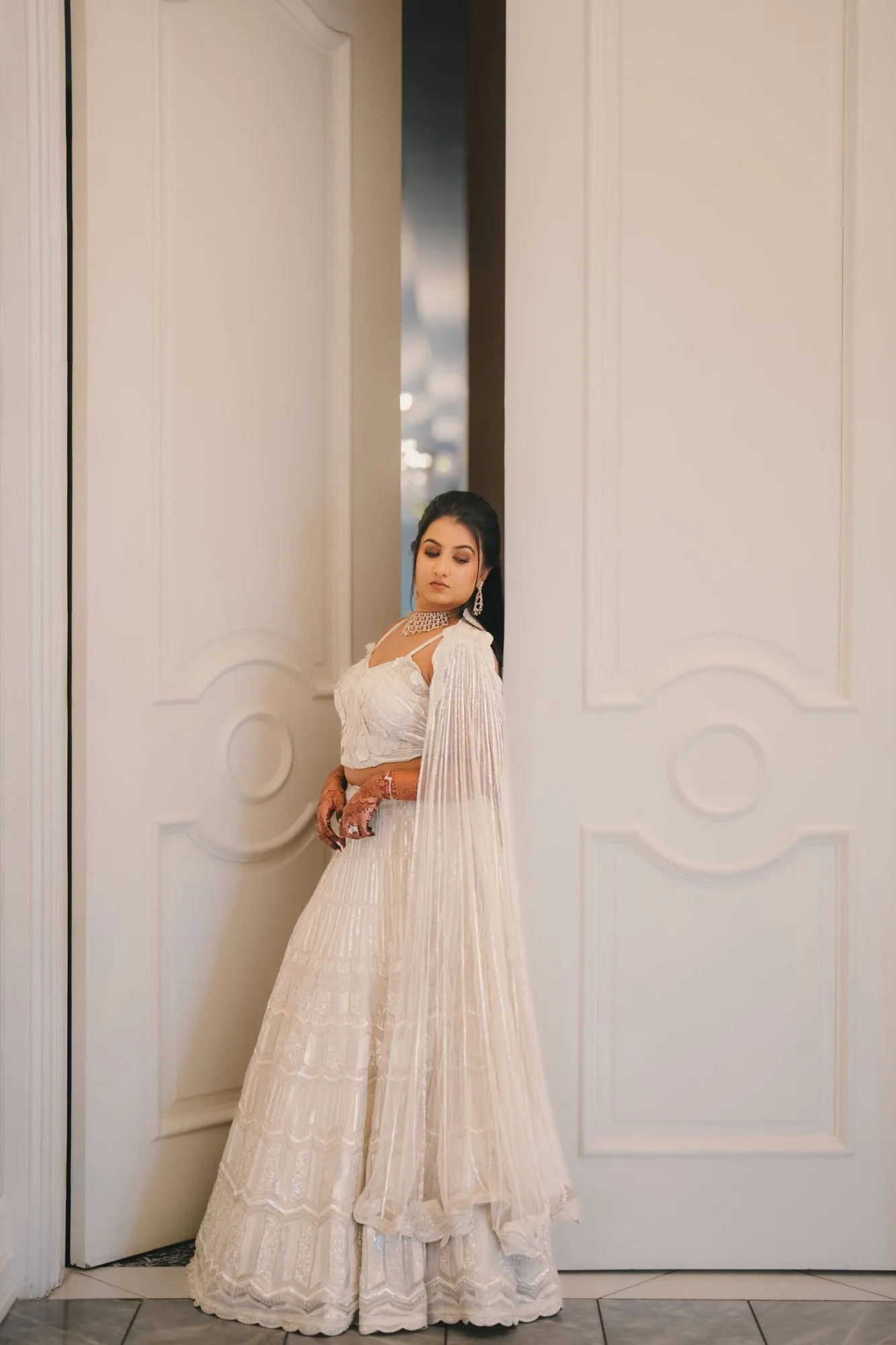
The baraat and the rukhsati
On the baraat day the groom’s family arrives at the bride’s family’s venue, with a procession at the door for Pakistani families, a dinner, and then the rukhsati: the bride’s farewell, with the Quran held over her head by her father or brother as she leaves. It is the emotional centre of the whole week, and we treat it the way we treat a vidaai or a doli: a longer lens, no direction, no flash, and a photographer at the car so the frame of the bride at the window is not lost. Agree where the car will stop and who holds the Quran; the frame of the father’s arm above her is the one the family keeps.
The walima
The walima is the groom’s family’s reception, usually the following day or a week later, and it is the formal, photographic event of the week: the couple on the stage, the family portraits in their best outfits, the guests greeting the couple one table at a time. We light the stage so the portraits there are properly lit without flattening the décor, work through the family list quickly, and the film team records the speeches and the duas in full.
Fusion weekends
A nikah alongside a Hindu ceremony, or a Muslim and a Christian family sharing one weekend, is a regular part of our calendar; each ceremony gets its own hour in the timeline and its own etiquette. Our guide to fusion and interfaith weddings and the wedding photographer in New Jersey page cover how two ceremonies share one day. Bangladeshi Hindu weddings are on our Bengali wedding photographer page.
How do we book?
Send us your dates, your venues and anything we should know about separate halls or who may be photographed. Surya replies personally within 24 hours, then a twenty-minute call, then a written proposal itemised to the dollar. See packages and prices, our guide to Muslim and Pakistani wedding photography, or check your date.
What couples wrote on Google
"What an amazing experience with Suriya Ji photography and Videography. Big THANK YOU. He and his team is simply amazing. We had a very unique request as we went to NJ…" — Zaki Khanzada
"Having Surya capture our special day was one of the best decisions. His entire team was great to work with and made us very comfortable. The quality of both the pictures and videos was beyond amazing" — Sharoz Zaheer
Questions Muslim couples ask us
Do you photograph Muslim weddings?
Yes. Pakistani, Indian Muslim and Bangladeshi weddings are a regular part of every season: the mehndi, the nikah, the baraat and rukhsati, and the walima, across New Jersey and New York.
Can you provide a female photographer for the ladies’ hall?
Yes. When the mehndi, the nikah or the reception is held with men and women in separate halls or behind a partition, a female photographer covers the ladies’ side, and we agree in advance who may be photographed and where.
Will our photographs be posted online?
Not without your permission. Galleries are private and password-protected, and nothing appears on our own pages unless the couple has agreed to it.
Can you photograph the nikah inside a mosque?
Usually yes, from the back and the sides and without flash. We confirm with the imam beforehand where we may stand and whether photography is permitted in the prayer hall.
Our rukhsati will be after midnight. Is that a problem?
No. Late timings are normal for a Pakistani baraat. The evening is photographed under our own soft light, and coverage is priced by event rather than by the hour.
How much does a Muslim wedding photographer cost in New Jersey?
Single-celebration collections begin in the mid four figures, and most couples who celebrate across a full wedding week make a five-figure investment, set out in a written, itemised proposal.
Your nikah and walima
Tell us your dates, your venues and what we should know about the etiquette. Surya replies personally within 24 hours.
Check Your Date